Your Welcome!

Your welcome to the Motionnet Blog !!!

Entertainment

Hot news in the World entertainment industry...

Technological

Daily update in the technological industry and the business World......

Download

Free download open source software,game's and etc........

Freelance Jobs

Showing posts with label World. Show all posts

U.S.-based inventors lead world in nanotechnology patents: study


Thu Feb 14, 2013 11:26am EST


n">(Reuters) - Inventors based in the United States led the world in nanotechnology patent applications and grants in 2012, according to a new study by law firm McDermott Will & Emery.


Nanotechnology involves manipulating matter that's measured at the tiny "nanometer" length level. The diameter of a human hair is between 40,000 and 60,000 nanometers, said Valerie Moore, a patent agent and one of the authors of the study.


Nanotechnology patents come into play in everything from aerospace to medicine to energy, the study noted. For example, the technology can be used to incorporate antibacterial material into wound dressings, to increase the strength of car parts while decreasing their weight, and to enhance paint colors.


U.S.-based inventors accounted for 54 percent of the nanotechnology patent applications and grants reviewed in the study, followed by South Korea with 7.8 percent, Japan with 7.1 percent, Germany with 6.2 percent and China with 4.9 percent.


The study also looked at the geographic location of the owner of the nanotechnology patents and proposed patents. If an inventor works in the Silicon Valley office of South Korea's Samsung Electronics Co, for instance, the U.S. is home to the invention, but the South Korean employer might own the patent.


McDermott's intellectual property practice includes more than 200 attorneys and patent agents, and is one of the top ten law firms for nanotech patent and applications filings, according to information provided by the firm.


McDermott partner Carey Jordan noted that the percentage of patents issued to U.S.-based entities is not quite as high as the 54 percent of nanopatents with U.S.-based inventors. About 45 percent of the nanotechnology patents in the study were assigned to U.S.-based entities.


The study examined published U.S. patent applications, patents granted by the U.S. Patent and Trade Office, and published international patent applications that had the term "nano" in the claims, title, or abstract. Nanopatent applications were included to best quantify innovation occurring in nanotech, the study's authors said.


The number of nanotechnology patents has grown continuously since the early 2000s, the study said. Between 2007 and 2012 the total number of U.S. patent applications, U.S. granted patents and published international patent applications grew from about 14,250 to almost 18,900.


The United States, the European Union, as well as Japan and South Korea, have increased funding for nanotechnology education and research since 2000, the study said.


Computer and electronics companies garnered the most patents, with International Business Machines Corp and Samsung topping the list. The fields of chemistry and biological sciences, which include medicine and agriculture, were next in terms of the number of nanotechnology patents.


Other leaders in technology patent innovation include the University of California, Xerox Corp, the Massachusetts Institute of Technology, and 3M Co.


(Reporting By Erin Geiger Smith; Editing by Nick Zieminski)


(This story was corrected to fix dateline and name of law firm in the first paragraph)


View the original article here

Vomiting Larry battles "Ferrari of the virus world"

Paramedics dressed in protective attire walk in front of the ship, the Bellriva, in Wiesbaden December 8, 2012. The Bellriva has been quarantined after at least 30 passengers were found to be suffering from diarrhoea and vomiting. Authorities believed it is caused by the Norovirus, a virus that is spread from person-to-person and causes flu-like symptoms. REUTERS/Lisi Niesner

Paramedics dressed in protective attire walk in front of the ship, the Bellriva, in Wiesbaden December 8, 2012. The Bellriva has been quarantined after at least 30 passengers were found to be suffering from diarrhoea and vomiting. Authorities believed it is caused by the Norovirus, a virus that is spread from person-to-person and causes flu-like symptoms.

Credit: Reuters/Lisi Niesner

By Kate Kelland, Health and Science Correspondent

LONDON | Mon Dec 31, 2012 8:53am EST

LONDON (Reuters) - Poor Larry isn't looking too good. He's pale and clammy and he's been projectile vomiting over and over again while his carers just stand by and watch.

Yet their lack of concern for Larry is made up for by their intense interest in how far splashes of his vomit can fly, and how effectively they evade attempts to clean them up.

Larry is a "humanoid simulated vomiting system" designed to help scientists analyze contagion. And like millions around the world right now, he's struggling with norovirus - a disease one British expert describes as "the Ferrari of the virus world".

"Norovirus is one of the most infectious viruses of man," said Ian Goodfellow, a professor of virology at the department of pathology at Britain's University of Cambridge, who has been studying noroviruses for 10 years.

"It takes fewer than 20 virus particles to infect someone. So each droplet of vomit or gram of feces from an infected person can contain enough virus to infect more than 100,000 people."

Norovirus is hitting hard this year - and earlier too.

In Britain so far this season, more than a million people are thought to have suffered the violent vomiting and diarrhea it can bring. The Health Protection Agency (HPA) said this high rate of infection relatively early in the winter mirrors trends seen in Japan and Europe.

"In Australia the norovirus season also peaks during the winter, but this season it has gone on longer than usual and they are seeing cases into their summer," it said in a statement.

In the United States, the Centers for Disease Control and Prevention (CDC) say norovirus causes 21 million illnesses annually. Of those who get the virus, some 70,000 require hospitalization and around 800 die each year.

PROFUSE AND PROJECTILE

Norovirus dates back more than 40 years and takes its name from the U.S. city of Norwalk, Ohio, where there was an outbreak of acute gastroenteritis in school children in November 1968.

Symptoms include a sudden onset of vomiting, which can be projectile, and diarrhea, which may be profuse and watery. Some victims also suffer fevers, headaches and stomach cramps.

John Harris, an expert on the virus at Britain's HPA, puts it simply: "Norovirus is very contagious and very unpleasant."

What makes this such a formidable enemy is its ability to evade death from cleaning and to survive long periods outside a human host. Scientists have found norovirus can remain alive and well for 12 hours on hard surfaces and up to 12 days on contaminated fabrics such as carpets and upholstery. In still water, it can survive for months, maybe even years.

At the Health and Safety Laboratory in Derbyshire, northern England, where researcher Catherine Makison developed the humanoid simulated vomiting system and nicknamed him "Vomiting Larry", scientists analyzing his reach found that small droplets of sick can spread over three meters.

"The dramatic nature of the vomiting episodes produces a lot of aerosolized vomit, much of which is invisible to the naked eye," Goodfellow told Reuters.

Larry's projections were easy to spot because he had been primed with a "vomitus substitute", scientists explain, which included a fluorescent marker to help distinguish even small splashes - but they would not be at all easily visible under standard white hospital lighting.

Add the fact that norovirus is particularly resistant to normal household disinfectants and even alcohol hand gels, and it's little wonder the sickness wreaks such havoc in hospitals, schools, nursing homes, cruise ships and hotels.

During the two weeks up to December 23, there were 70 hospital outbreaks of norovirus reported in Britain, and last week a cruise ship that sails between New York and Britain's Southampton docked in the Caribbean with about 200 people on board suffering suspected norovirus.

MOVING TARGET

The good news, for some, is that not everyone appears to be equally susceptible to norovirus infection. According to Goodfellow, around 20 percent of Europeans have a mutation in a gene called FUT2 that makes them resistant.

For the rest the only likely good news will have to wait for the results of trials of a potential norovirus vaccine developed by U.S. drugmaker LigoCyte Pharmaceuticals Inc, or from one of several research teams around the world working on possible new antiviral drugs to treat the infection.

Early tests in 2011 indicated that around half of people vaccinated with the experimental shot, now owned by Japan's Takeda Pharmaceutical Co, were protected from symptomatic norovirus infection.

The bad news, virologists say, is that the virus changes constantly, making it a moving target for drug developers. There is also evidence that humans' immune response to infection is short-lived, so people can become re-infected by the same virus within just a year or two.

"There are many strains, and the virus changes very rapidly - it undergoes something virologists call genetic drift," Harris said in a telephone interview. "When it makes copies of itself, it makes mistakes in those copies - so each time you encounter the virus you may be encountering a slightly different one."

This means that even if a vaccine were to be fully developed - still a big 'if' - it would probably need to be tweaked and repeated in a slightly different formula each year to prevent people getting sick.

Until any effective drugs or vaccines are developed, experts reckon that like the common cold, norovirus will be an unwelcome guest for many winters to come. Their advice is to stay away from anyone with the virus, and use soap and water liberally.

"One of the reasons norovirus spreads so fast is that the majority of people don't wash their hands for long enough," said Goodfellow. "We'd suggest people count to 15 while washing their hands and ensure their hands are dried completely."

(Reporting by Kate Kelland; Editing by Will Waterman)


View the original article here

Cost of combating climate change surges as world delays: study

The sun rises behind Fiddlers Ferry coal fired power station near Liverpool, northern England, December 15 2008. REUTERS/Phil Noble

The sun rises behind Fiddlers Ferry coal fired power station near Liverpool, northern England, December 15 2008.

Credit: Reuters/Phil Noble


OSLO | Thu Jan 3, 2013 7:15am EST


OSLO (Reuters) - An agreement by almost 200 nations to curb rising greenhouse gas emissions from 2020 will be far more costly than taking action now to tackle climate change, according to research published on Wednesday.


Quick measures to cut emissions would give a far better chance of keeping global warming within an agreed U.N. limit of 2 degrees Celsius (3.6F) above pre-industrial times to avert more floods, heatwaves, droughts and rising sea levels.


"If you delay action by 10, 20 years you significantly reduce the chances of meeting the 2 degree target," said Keywan Riahi, one of the authors of the report at the International Institute for Applied Systems Analysis in Austria.


"It was generally known that costs increase when you delay action. It was not clear how quickly they change," he told Reuters of the findings in the science journal Nature based on 500 computer-generated scenarios.


It said the timing of cuts in greenhouse gases was more important than other uncertainties - about things like how the climate system works, future energy demand, carbon prices or new energy technologies.


The study indicated that an immediate global price of $30 a metric ton on emissions of carbon dioxide (CO2), the main greenhouse gas, would give a roughly 60 percent chance of limiting warming to below 2C.


Wait until 2020 and the carbon price would have to be around $100 a metric ton to retain that 60 percent chance, Riahi told Reuters of the study made with other experts in Switzerland, New Zealand, Australia and Germany.


And a delay of action until 2030 might put the 2C limit - which some of the more pessimistic scientists say is already unattainable - completely out of reach, whatever the carbon price.


"The window for effective action on climate change is closing quickly," wrote Steve Hatfield-Dodds of the Commonwealth Scientific and Industrial Research Organisation in Australia in a separate commentary in Nature.


Governments agreed to the 2C limit in 2010, viewing it as a threshold to avert dangerous climate change. Temperatures have already risen by 0.8 degree C (1.4F) since wide use of fossil fuels began 200 years ago.


ECONOMIC SLOWDOWN


After the failure of a 2009 summit in Copenhagen to agree a worldwide accord, almost 200 nations have given themselves until 2015 to work out a global deal to cut greenhouse gas emissions that will enter into force in 2020.


Amid an economic slowdown, many countries at the last U.N. meeting on climate change in Qatar in December expressed reluctance to make quick shifts away from fossil fuels towards cleaner energies such as wind or solar power.


Each U.S. citizen, for instance, emits about 20 metric tons of carbon dioxide a year. There is no global price on carbon, only regional markets - in a European Union trading system, for instance, where industrial emitters must pay off they exceed their CO2 quotas, 2013 prices are about 6.7 euros ($8.83) a metric ton.


The report also showed that greener policies, such as more efficient public transport or better-insulated buildings, would raise the chances of meeting the 2C goal.


And fighting climate change would be easier with certain new technologies, such as capturing and burying carbon emissions from power plants and factories. In some scenarios, the 2C goal could not be met unless carbon capture was adopted.


($1 = 0.7585 euros)


(Scientist corrects carbon price to $30 a tonne from $20 in paragraph 6)


(Editing by Robin Pomeroy)


View the original article here

World Chefs: Phan shares food, journey from Vietnam


NEW YORK | Tue Oct 9, 2012 5:06am EDT


NEW YORK (Reuters) - Vietnamese-born chef Charles Phan shares his passion for his homeland and tips about how to cook its delicious food in his first cookbook, "Vietnamese Home Cooking".


Phan and his family fled to Guam from Vietnam in 1975 before settling in San Francisco a couple of years later. In 1995 he opened his restaurant Slanted Door, which has won acclaim for its modern interpretation of traditional Vietnamese food. He now runs six other eateries in San Francisco.


The 50-year-old spoke to Reuters about his passion for Vietnamese food, his plan to open a New Orleans-inspired bar and his future plans.


Q: What is the goal of your first cookbook?


A: "It's way to spread the gospel, if you will, about Vietnamese culture and food. We try to do that with our restaurant. The book is another way of bringing that culture to you."


Q: What makes Vietnamese cuisine unique?


A: "The Vietnamese were conquered by the French and the Chinese. On a Vietnamese table, there is always a big platter of fresh vegetable and herbs. In Vietnam, up north, the food is a bit different from the south. You have different climates. In Saigon, it's hot and muggy and tropical so the country ranges pretty widely with its food."


Q: What does Vietnamese cooking have in common with others in Southeast Asia?


A: "Obviously, rice is the common link across these cultures. They use meat as condiments rather than a main course. We don't have ovens so we don't bake things. We steam things. Fuel is scarce so we use very little wood. You have the fruits and vegetables that come from Southeast Asia you use over there. When you compare all of Southeast Asia with Laos, Cambodia, Thailand, they are very similar. Things get different when you get into China."


Q: You have plans to open another restaurant?


A: "We are about to open to Creole bar concept. I happen to like bourbon a lot; so does my architect. So this bar will have an extensive bourbon list and interesting bourbon from the last three years. It's tiny. It's only 1,300 square feet. So the bar drives the concept. It's inspired by New Orleans. There will be oysters from New Orleans. We'll have gumbo. We'll make a mean fried chicken."


Q: Do you have second thoughts about serving Creole food?


A: "I cook all this food at home all the time. I'm not saying I'm an expert at it but it's simple enough and it's high quality food .... You don't have be Vietnamese to cook Vietnamese food as long as you understand the sensibility."


Q: What should one be mindful of in making Vietnamese food?


A: "You have to learn how to eat Vietnamese food before you cook it. You have to understand what the sensibility is or what I call the gold standard. This is how the Vietnamese want it. This is how people in Vietnam treat their food. You might not agree.


"In Vietnam people like their meat medium to well done. You could change that. There's nothing wrong with that. Again in Vietnam, people eat their soup with herbs and lemon in it. But you don't have to do it. Cooking is knowing where you are going and achieving that goal."


Chicken Satay with Peanut Sauce (Makes 20 to 25 skewers; serves 10 to 12 as an appetizer)


2½ pounds skinless, boneless chicken thighs


¾ cup sliced shallots


¾ cup shallot oil or canola oil


2 tablespoons minced garlic


1½ tablespoons roasted chili paste


2 tablespoons sugar


2 teaspoons kosher salt


2 teaspoons mild Madras curry powder


Peanut sauce (see below)


Sriracha sauce, for seasoning


20 to 25 (10-inch) bamboo skewers


1. Trim any visible fat from the chicken thighs, then cut the thighs into long strips, about 1-inch wide. Put the chicken into a bowl and set aside.


2. To make the marinade, in a food processor or blender, combine the shallots and shallot oil and process until smooth. Add the garlic, chili paste, sugar, salt, and curry powder and process until smooth.


3. Add the marinade to the chicken and mix well to coat evenly. Cover and refrigerate for 3 hours. In a shallow dish, immerse the bamboo skewers in water to cover.


4. Prepare a medium-hot fire for direct-heat grilling in a charcoal grill (you should be able to hold your hand 1 inch above the grate for only 3 to 4 seconds).


5. Just before the coals are ready, drain the skewers and thread 1 strip of chicken lengthwise onto each skewer, taking care to insert the skewer through the center of each strip. Do not leave the tip of the skewer exposed or it will burn.


6. Place the skewers on the grill grate and cook, turning once, for 2 to 3 minutes on each side, until well browned and opaque throughout.


7. In a small bowl, stir together the peanut sauce with Sriracha to taste. Transfer the skewers to a large platter and serve immediately, accompanied with the sauce.


PEANUT SAUCE (makes about 2 cups)


1 cup sweet (glutinous) rice


1/2 cup roasted peanuts


2 cloves garlic


1 Thai chili, stemmed


3 tablespoons red miso


3 tablespoons ketchup


3 tablespoons canola oil


3 tablespoons sugar


2 tablespoons vegetarian stir-fry (aka vegetarian oyster) sauce


1-1/2 teaspoons freshly squeezed lemon juice


1/2 teaspoon toasted sesame oil


1. Rinse the rice in a fine-mesh sieve until the water runs clear, then transfer to a heavy-bottomed pot with a lid. Add 2 cups of water and bring to a boil over high heat. Decrease the heat to low, cover, and cook for about 15 minutes, until the water is absorbed and the rice is tender. Remove from the heat and let stand, covered for 10 minutes. Then uncover, fluff with a fork, and let cool to room temperature. Alternatively, the rice can be prepared in a rice cooker.


2. In a food processor, combine the cooled rice, peanuts, garlic, chili, miso, ketchup, canola oil, sugar, stir-fry sauce, lemon juice and sesame oil and process until the mixture is a fine paste. Thin with water (about 1/2 cup) until the texture is smooth and creamy. Transfer to a bowl, cover and refrigerate until ready to serve. The sauce will keep, refrigerated, for up to four days.


(Reporting by Richard Leong; editing by Patricia Reaney and Richard Chang)


View the original article here

"Winter of the World" debuts on top of U.S. bestseller list

n">(Reuters) - Ken Follett's "Winter of the World" debuted at the top spot on Publishers Weekly's bestseller list on Thursday.

The list is compiled using data from independent and chain bookstores, book wholesalers and independent distributors nationwide.

Hardcover Fiction Last Week

1. "Winter of the World" by Ken - (Follett Dutton, $36.00)

2. "A Wanted Man" by Lee Child 1 (Delacorte, $28.00)

3. "The Time Keeper" by Mitch Albom 2 (Hyperion, $24.99)

4. "Gone Girl" by Gillian Flynn 5 (Crown, $25.00)

5. "Low Pressure" by Sandra Brown - (Grand Central, $26.99)

6. "Zoo" by James Patterson/ Michael 4 Ledwidge (Little, Brown, $27.99)

7. "Severe Clear" by Stuart Woods - (Putnam, $26.95)

8. "Delusion in Death" by J.D. Robb 3 (Putnam, $27.95)

9. "The Tombs" by Clive Cussler 6 (Putnam, $27.95)

10. "Telegraph Avenue" by Michael 7 Chabon (Harper, $27.99)

Hardcover Nonfiction

1. "No Easy Day" by Mark Owen 1 (Dutton, $26.95)

2. "I Declare: 31 Promises to Speak" by - Joel Osteen (FaithWords, $21.99)

3. "The Price of Politics" by Bob 2 Woodward (Simon & Schuster, $30.00)

4. "Guinness World Records 2013" 4 (Guinness World Records)

5. "Divine Healing Hands" by Zhi Gang 3 Sha (Atria, $29.95)

6. "Joseph Anton: A Memoir" by Salman - Rushdie (Random House, $30.00)

7. "Killing Lincoln" by Bill O'Reilly & 7 Martin Dugard (Holt, $28.00)

8. "The Oath: The Obama White House" by - Jeffrey Toobin (Doubleday, $28.95)

9. "Free Market Revolution" by Brook/ - Watkins (Palgrave Macmillan, $27.00)

10. "Obama's America" by Dinesh D'Souza 5 (Regnery, $ 27.95)

Week ending Sept 23, 2012, powered by Nielsen BookScan (c) 2012 The Nielsen Company.

(Editing by Piya Sinha-Roy)


View the original article here

Rowling leaves door ajar to return to Potter "world"

Author J.K Rowling poses for photos with her certificate after being presented with the Freedom of the City of London, at Mansion House, central London May 8, 2012. REUTERS/Andrew Winning

Author J.K Rowling poses for photos with her certificate after being presented with the Freedom of the City of London, at Mansion House, central London May 8, 2012.

Credit: Reuters/Andrew Winning


NEW YORK/LONDON | Wed Sep 26, 2012 4:09pm EDT


NEW YORK/LONDON (Reuters) - Harry's still finished, but don't rule out any return to the Potter world.


Although J.K. Rowling's first novel tailored for adults is being released this week, she says her next book will likely be a children's book, and in the future she may pen a story related to the Harry Potter universe.


"I think it very likely that the next thing I publish will be for kids. I have a children's book that I really like, it's for slightly younger children than the Potter books," Rowling told the BBC in a television interview broadcast on Wednesday.


In one of a handful of appearances to promote "The Casual Vacancy," which hits bookstores worldwide on Thursday, Rowling told the BBC: "Truly, where Harry's story is concerned, I'm done.


Yet the 47-year-old best-selling British author did not rule out a Potter spin-off, while she was adamant it would never be for commercial reasons. The seven "Harry Potter" books have sold more than 450 million books worldwide.


"I have always left the door ajar because I'm not that cruel. If I had a fabulous idea that came out of that world, because I loved writing it, I would do it," she told the BBC.


"But I've got to have a great idea, I don't want to go mechanically into that world and pick up odds and ends and glue them together and say 'Here we go, we can sell this'. It would make a mockery of what those books were to me."


Were that great idea to come, she said: "I probably would do it. I'm very averse to the prequel/sequel idea. I've never seen it work well in either literature or film. That's a personal preference."


Rowling, who started her writing career as a financially struggling, single mother, said while there was clearly "an appetite for eight, nine, ten," Potter novels, she knew she only had enough plot for seven books about Harry's magical adventures.


"To go further would have been money for old rope. Couldn't do it. And that's largely why I slapped on that epilogue (in the final "Harry Potter" novel). (It) says he's leading a quiet life, and he's earned it. He's done," she said of the boy wizard.


POTTER DIRECTOR'S CUT, TEEN OCD


Rowling said she would have liked more time to work on some of the books.


"I had to write on the run and there were times when it was really tough. And I read them, and I think 'Oh God, maybe I'll go back and do a director's cut". I don't know," she said in BBC interview.


"But you know what?" she added. "I'm proud I was writing under the conditions under which I was writing. No one will ever know how tough it was at times."


In a separate interview with ABC's "Nightline", Rowling revealed that she had signs of obsessive-compulsive behavior when she was a teenager, and that one of the characters in "The Casual Vacancy" was drawn from her own experiences.


"These are things I know from the inside," she said in the interview, some of which was aired on "Good Morning America" on Wednesday. "When I was in my teens, I had issues with OCD ... checking things, it's very common, double checking, triple checking, it's an anxiety disorder."


Rowling has spoken openly in the past about dealing with depression, which she estimated she had not had to deal with for more than a decade.


She credited Harry Potter with helping. "Forget the money," she said; it gave her self-respect. "Harry gave me a job that I loved to do more than anything else," she told ABC.


(Additional reporting by Mike Collett-White in London, editing by Jill Serjeant and Gunna Dickson)


View the original article here

Sleeping Dogs (video game)

Sleeping Dogs is a 2012 open world action-adventure video game developed by United Front Games in conjunction with Square Enix London Studios and published by Square Enix, released on August 14, 2012, for Microsoft Windows, PlayStation 3, and Xbox 360. Sleeping Dogs takes place in Hong Kong and focuses on an undercover operation to infiltrate the Triads.

The game was originally in development as an original IP, but was announced in 2009 as True Crime: Hong Kong, the third installment and a reboot of the True Crime series.As a result of the game’s high development budget and delays, it was canceled by Activision in 2011. Six months later, it was announced that Square Enix had picked up the publishing rights to the game, but the game was renamed Sleeping Dogs in 2012 since Square Enix did not purchase the True Crime name rights.


Wikipedia

THE MAYAN # 4

The King and his Court


A typical Classic Maya polity was a small hierarchical state (ajawil, ajawlel, or ajawlil) headed by a hereditary ruler known as an ajaw (later k’uhul ajaw). Such kingdoms were usually no more than a capital city with its neighborhood and several lesser towns, although there were greater kingdoms, which controlled larger territories and extended patronage over smaller polities.[citation needed] Each kingdom had a name that did not necessarily correspond to any locality within its territory. Its identity was that of a political unit associated with a particular ruling dynasty. For instance, the archaeological site of Naranjo was the capital of the kingdom of Saal. The land (chan ch’e’n) of the kingdom and its capital were called Wakab’nal or Maxam and were part of a larger geographical entity known as Huk Tsuk. Interestingly, despite constant warfare and eventual shifts in regional power, most kingdoms never disappeared from the political landscape until the collapse of the whole system in the 9th century AD. In this respect, Classic Maya kingdoms are highly similar to late Post Classic polities encountered by the Spaniards in Yucatán and Central Mexico: some polities could be subordinated to hegemonic rulers through conquests or dynastic unions and yet even then they persisted as distinct entities.[citation needed]

Mayanists have been increasingly accepting a "court paradigm" of Classic Maya societies which puts the emphasis on the centrality of the royal household and especially the person of the king. This approach focuses on Maya monumental spaces as the embodiment of the diverse activities of the royal household. It considers the role of places and spaces (including dwellings of royalty and nobles, throne rooms, temples, halls and plazas for public ceremonies) in establishing power and social hierarchy, and also in projecting aesthetic and moral values to define the wider social realm.

Spanish sources invariably describe even the largest Maya settlements as dispersed collections of dwellings grouped around the temples and palaces of the ruling dynasty and lesser nobles. None of the Classic Maya cities shows evidence of economic specialization and commerce of the scale of Mexican Tenochtitlan. Instead, Maya cities could be seen as enormous royal households, the locales of the administrative and ritual activities of the royal court. They were the places where privileged nobles could approach the holy ruler, where aesthetic values of the high culture were formulated and disseminated and where aesthetic items were consumed. They were the self-proclaimed centers and the sources of social, moral, and cosmic order. The fall of a royal court as in the well-documented cases of Piedras Negras or Copan would cause the inevitable "death" of the associated settlement.


source by Wikipedia


THE MAYAN # 3

Geographical extent


The Maya civilization extended throughout the present-day southern Mexican states of Chiapas, Tabasco, and the Yucatán Peninsula states of Quintana Roo, Campeche and Yucatán. The Maya area also extended throughout the northern Central American region, including the present-day nations of Guatemala, Belize, northern El Salvador and western Honduras.


The Maya area is generally divided into three loosely defined zones: the southern Pacific lowlands, the highlands, and the northern lowlands. The Maya highlands include all of elevated terrain in Guatemala and the Chiapas highlands. The southern lowlands lie just south of the highlands, and incorporate a part of the Mexican state of Chiapas, the south coast of Guatemala, Belize and El Salvador. The northern lowlands cover all of the Yucatán Peninsula, including the Mexican states of Yucatán, Campeche and Quintana Roo, the Petén Department of Guatemala, and all of Belize. Parts of the Mexican states of Tabasco and Chiapas are also included in the northern lowlands.


Source by Wikipedia

THE MAYAN # 2

Maya civilization


p to: navigation, search
Page semi-protected
This article is about the pre-Columbian Maya civilization. For a discussion of the modern Maya, see Maya peoples. For other meanings of the word Maya, see Maya.


The Maya is a Mesoamerican civilization, noted for the only known fully developed written language of the pre-Columbian Americas, as well as for its art, architecture, and mathematical and astronomical systems. Initially established during the Pre-Classic period (c. 2000 BC to AD 250), according to the Mesoamerican chronology, many Maya cities reached their highest state of development during the Classic period (c. AD 250 to 900), and continued throughout the Post-Classic period until the arrival of the Spanish.

The Maya civilization shares many features with other Mesoamerican civilizations due to the high degree of interaction and cultural diffusion that characterized the region. Advances such as writing, epigraphy, and the calendar did not originate with the Maya; however, their civilization fully developed them. Maya influence can be detected from Honduras, Guatemala, and western El Salvador to as far away as central Mexico, more than 1,000 km (620 mi) from the Maya area. Many outside influences are found in Maya art and architecture, which are thought to result from trade and cultural exchange rather than direct external conquest.

The Maya peoples never disappeared, neither at the time of the Classic period decline nor with the arrival of the Spanish conquistadores and the subsequent Spanish colonization of the Americas. Today, the Maya and their descendants form sizable populations throughout the Maya area and maintain a distinctive set of traditions and beliefs that are the result of the merger of pre-Columbian and post-Conquest ideas and cultures. Millions of people speak Mayan languages today; the Rabinal Achí, a play written in the Achi language, was declared a Masterpiece of the Oral and Intangible Heritage of Humanity by UNESCO in 2005.


Souse by Wikipedia

Mars Science Laboratory Curiosity Rover Animation

new photo of  Curiosity Rover


Mars Science Laboratory Curiosity Rover Animation


THE MAYAN


2012 Mayan vs Alien


tata megapixel

TATA MEGAPIXEL(CAR)


PRESS RELEASE


Tata Megapixel, a new global car concept, displayed at the 82nd Geneva Motor Show

Geneva,
March 6, 2012:

Tata Motors today presented at the 82nd Geneva Motor Show the Tata Megapixel, a new four-seater city-smart global range extended electric vehicle (REEV) concept for the performance-seeking and environment-conscious motorist anywhere in the world. Combining a lithium ion phosphate battery and an on-board petrol engine generator for recharging on the move, the Tata Megapixel offers a range of up to 900 km (with a single tank of fuel), path-breaking CO2 emission of just 22 gm / km and fuel economy of 100 km / litre (under battery only power).

Speaking on the occasion, Mr. Prakash M. Telang, Managing Director - India Operations, Tata Motors, said, “The Tata Megapixel, developed by our design centres in India, the UK and Italy, is our idea of a city car for discerning motorists in any megacity of the world. It is a result of the progress we have made on the Tata Pixel, displayed last year, and also denotes the company’s future design direction.”

The class-leading ‘Zero Turn’ drive system of the Tata Pixel (shown at the 2011 Geneva Motor Show) has been taken to an even higher level of manoeuvrability in the Tata Megapixel. The car’s electric drive has four independent electric motors, one at each wheel. When parking, the electric hub motors drive the wheels in opposite directions, while the front wheels are turned at an acute angle, enabling an exceptional 2.8 metre turning radius. The at-home charging system is an as innovative induction charging system. The car has simply to be parked over the induction pad for charging to begin.

The Tata Megapixel is as distinctive in elegantly melding Indian uniqueness – in colours, graphic themes or materials – with global styling preferences. The integrated lamp and grille graphics sweep back over the front wheel arches to render a dynamic front end. It is echoed on the panoramic roof, creating a harmony between sun & shade and sense of interior space. The floating C-pillar and wrap-around belt line finisher integrate perfectly with the sculpted body surface, flowing freely to the rear and encapsulating the 5-spoke wheel design.

A double-sliding door system and the car’s B-pillar less design make entry/exit easy, besides superb visibility. The battery layout and hub motors maximize the interior package. So, the Tata Megapixel comfortably accommodates four adults with luggage. The front seats are cantilevered on the central tunnel, releasing floor space for additional storage. Light leather trims and rose metal details accentuate the joyous marriage of richness of tradition and innovativeness of technology.

This fusion is heightened by an advanced human machine interface (HMI). The console docking point can connect a smart phone with the car. The built-in large touchscreen HMI, at the centre of the instrument panel, thus becomes a common access point for the repertoire of the smart device and for controlling the functions of the car, like temperature, ventilation, driving modes and performance.

Tata Motors’ displays also include the new generation Tata Safari Storme SUV, the Tata Aria crossover, the Tata Indigo Manza sedan and the Tata Indica Vista hatchback.

About Tata Motors
Tata Motors is India's largest automobile company, with consolidated revenues of Rs. 1,23,133 crores ($ 27 billion) in 2010-11. Through subsidiaries and associate companies, Tata Motors has operations in the UK, South Korea, Thailand, Spain and South Africa. Among them is Jaguar Land Rover, the business comprising the two iconic British brands. It also distributes Fiat cars in India, and has an industrial joint venture with Fiat in India. With over 6.5 million Tata vehicles plying in India, Tata Motors is the country’s market leader in commercial vehicles and among the top three in passenger vehicles. It is also the world's fourth largest truck manufacturer and the third largest bus manufacturer. Tata cars, buses and trucks are being marketed in several countries in Europe, Africa, the Middle East, South Asia, South East Asia and South America. (www.tatamotors.com)


TECHNOLOGY


OVERVIEW


  • Range Extended Electric Vehicle - enabling a combined range of up to 900 km.
  • CO2 emissions of just 22 g/km and fuel economy of 100 km/litre under a combined driving mode (as per ECE R101).
  • ‘Zero Turn’drive maximizes manoeuvrability when parking.

The Tata Megapixel, a range extended electric vehicle (REEV), is a new four-seater city-smart global car concept for the performance-seeking and environment-conscious motorist anywhere in the world.

Combining a lithium ion phosphate battery and an on-board petrol engine generator for recharging on the move, the Tata Megapixel offers a range of up to 900 km (with a single tank of fuel), path-breaking CO2 emissions of just 22 g/km and fuel economy of 100 km/litre under a combined driving mode (as per ECE R101). At home charging is via an innovative inductive charging system. The car has simply to be parked over the induction pad for charging to begin.

The class-leading ‘Zero Turn’ drive system of the Tata Pixel (shown at the 2011 Geneva Motor Show) has been taken to an even higher level of manoeuvrability in the Tata Megapixel. The car’s electric drive has four independent electric motors, one at each wheel. When parking, the electric hub motors drive the wheels in opposite directions, while the front wheels are turned at an acute angle, enabling an exceptional 2.8 metre turning radius.

The Tata Megapixel is as distinctive in elegantly melding Indian uniqueness – in colours, graphic themes or materials – with global styling preferences. The integrated lamp and grille graphics sweep back over the front wheel arches to render a dynamic front end. It is echoed on the panoramic roof, creating a harmony between sun & shade and sense of interior space. The floating C-pillar and wrap-around belt line finisher integrate perfectly with the sculpted body surface, flowing freely to the rear and encapsulating the 5-spoke wheel design.

A double-sliding door system and the car’s B-pillar less design make entry/exit easy, besides superb visibility. The battery layout and hub motors maximize the interior package. So, the Tata Megapixel comfortably accommodates four adults with luggage. The front seats are cantilevered on the central tunnel, releasing floor space for additional storage. Light leather trims and rose metal details accentuate the joyous marriage of richness of tradition and innovativeness of technology.

This fusion is heightened by an advanced human machine interface (HMI). The console docking point can connect a smart phone with the car. The built-in large touchscreen HMI, at the centre of the instrument panel, thus becomes a common access point for the repertoire of the smart device and for controlling the functions of the car, like temperature, ventilation, driving modes and performance.

The Tata Megapixel denotes Tata Motors’ progression from the Tata Pixel, based on the Tata Nano and a city car concept for Europe, reflecting the company’s future design direction

KEY FEATURES


Design

  • Unique ‘India Global’ exterior and interior design language 
  • Panoramic roof 
  • Light and spacious, elegant interior
  • Cantilevered seating system
  • Comfortable seating for four adults 
  • Ergonomic ‘all in one,’ touch screen command centre


Drive system and performance

  • Electric drive through four independent in-wheel motors 
  • On-board recharging from auxiliary power unit 
  • Maximum vehicle range of over 900 km, including battery range of 87 km 
  • Optimised weight distribution and All-Wheel-Drive for agile handling 
  • Low rolling resistance tyres


City wise

  • ‘Hands free’ induction battery charging 
  • Advanced double sliding side door system for easy entry and egress in confined spaces 
  • Compact dimensions and good all round visibility 
  • Zero turn manoeuvrability with park assist system 
  • ‘Hands on’ connectivity via in-vehicle display and smart phone 
  • In-car access to your online world 
  • Integrated ‘infotainment plus’ system with control over key vehicle functions and entertainment system


GOOGLE vs NOKIA

google project glass  VS  nokia future technologies glasses


WHAT DO YOU THINK? See now...


GOOGLE PROJECT GLASS :


NOKIA  FUTURE TECHNOLOGIES GLASSES :


USAIN BOLT TO ENTER CRICKET

Usain Bolt to enter to play cricket:


It is reported reliably that these days the London Olympic Games 2012 most popular participant Usain Bolt is preparing himself to play in 20/20 cricket.
Do you aware that he was a crazy cricket lover from his younger days?
Bolts country of origin is located close to a number of West Indian Islands from where several cricketing legends had emerged. It is Jamaica located in the midst of these Caribbean islands.
His father had played the game of cricket and had thought from his younger days the finer points of the game of Cricket. The other day Shane Warne having come to know that Usain Bolt is keen on cricket and could play the game had invited him to play in his 20/20 ‘Big Bash’ League tournament to be held in Australia.
In the year 2009 Usain Bolt had shown successfully his cricketing prowess when he represented a team led by Chris Gayle in a charity 20/20 match as a fast bowler.Recently Bolt has had an interview with an Australian television channel in which he had shown his interest in the proposed 20/20 league tournament. What he had stated was as follows:
“I like the 20/20 game, it’s format and it’s concept. It ends rather quickly. One could see some huge hits. While batting by hitting huge sixes the batsmen could arose the anger of the bowlers of the opposition. It is not like sprinting. It gives immense pleasure to the players as well as to the spectators.”
In the meantime during the tenure of the Olympic Games 2012, the Manager of the Manchester United football team has had discussions with Bolt requesting him to join his English League football team’


source by

2012 Miss World From China

Miss World 2012 is Wenxia YU from The Peoples Republic of China.

In a glittering ceremony held at the Dongsheng Stadium Wenxia YU won the title of Miss World 2012. In a record breaking year 116 contestants represented their countries on the world stage in what was a celebration of Ordos and a gathering of friends from around the world.


Romney tours Warsaw's World War II monuments

About Reuters TV

Hard-edged reporting, insight and analysis, Reuters TV breaks ground creating informative news and financial videos. Showcasing Reuters’ 3000 award-winning journalists, Reuters TV delivers high-energy investigative journalism with concise explanations. Check it out and let us know what you think.


View the original article here

Interplanetary Internet ( ipn )

The Interplanetary Internet (based on IPN, also called InterPlaNet) is a conceived computer network in space, consisting of a set of network nodes which can communicate with each other. Communication would be greatly delayed by the great interplanetary distances, so the IPN needs a new set of protocols and technology that are tolerant to large delays and errors. While the Internet as we know it tends to be a busy network of networks with high traffic, negligible delay and errors, and a wired backbone, the Interplanetary Internet is a store-and-forward network of internets that is often disconnected, has a wireless backbone fraught with error-prone links and delays ranging to tens of minutes, even hours, even when there is a connection.
The speed of light, illustrated here by a beam of light travelling from the Earth to the Moon, would limit the speed at which Interplanetary Internet messages would be able to travel. In this example, it takes light 1.26 seconds to travel from the Earth to the Moon. Due to the vast distances involved, much longer delays may be incurred than in the Earth-bound Internet.

Development


Space communication technology has steadily evolved from expensive, one-of-a-kind point-to-point architectures, to the re-use of technology on successive missions, to the development of standard protocols agreed upon by space agencies of many countries. This last phase has gone on since 1982 through the efforts of the Consultative Committee for Space Data Systems (CCSDS), a body composed of the major space agencies of the world. It has 11 member agencies, 22 observer agencies, and over 100 industrial associates.

The evolution of space data system standards has gone on in parallel with the evolution of the Internet, with conceptual cross-pollination where fruitful, but largely as a separate evolution. Since the late 1990s, familiar Internet protocols and CCSDS space link protocols have integrated and converged in several ways, for example, the successful FTP file transfer to Earth-orbiting STRV-1b on January 2, 1996, which ran FTP over the CCSDS IPv4-like Space Communications Protocol Specifications (SCPS) protocols. Internet Protocol use without CCSDS has taken place on spacecraft, e.g., demonstrations on the UoSAT-12 satellite, and operationally on the Disaster Monitoring Constellation. Having reached the era where networking and IP on board spacecraft have been shown to be feasible and reliable, a forward-looking study of the bigger picture was the next phase.
The Interplanetary Internet study at NASA's Jet Propulsion Laboratory (JPL) was started by a team of scientists at JPL led by Vinton Cerf and Adrian Hooke. Cerf is one of the pioneers of the Internet on Earth, and currently holds the position of distinguished visiting scientist at JPL. Hooke is one of the directors of the CCSDS.
ICANN meeting, Los Angeles, USA, 2007. The marquee pays a humorous homage to the Ed Wood film Plan 9 from Outer Space, while namedropping Internet pioneer Vint Cerf.

While IP-like SCPS protocols are feasible for short hops, such as ground station to orbiter, rover-to-lander, lander-to-orbiter, probe-to-flyby, and so on, delay-tolerant networking is needed to get information from one region of the solar system to another. It becomes apparent that the concept of a "region" is a natural architectural factoring of the InterPlanetary Internet.

A "region" is an area where the characteristics of communication are the same. Region characteristics include communications, security, the maintenance of resources, perhaps ownership, and other factors. The Interplanetary Internet is a "network of regional internets."

What is needed then, is a standard way to achieve end-to-end communication through multiple regions in a disconnected, variable-delay environment using a generalized suite of protocols. Examples of regions might include the terrestrial Internet as a region, a region on the surface of the moon or Mars, or a ground-to-orbit region.
The recognition of this requirement led to the concept of a "bundle" as a high-level way to address the generalized Store-and-Forward problem. Bundles are an area of new protocol development in the upper layers of the OSI model, above the Transport Layer with the goal of addressing the issue of bundling store-and-forward information so that it can reliably traverse radically dissimilar environments constituting a "network of regional internets."

Bundle Service Layering, implemented as the Bundling protocol suite for delay-tolerant networking, will provide general purpose delay-tolerant protocol services in support of a range of applications: custody transfer, segmentation and reassembly, end-to-end reliability, end-to-end security, and end-to-end routing among them. The Bundle Protocol was first tested in space on the UK-DMC satellite in 2008.
An example of one of these end-to-end applications flown on a space mission is CFDP, used on the comet mission, Deep Impact. CFDP is the CCSDS File Delivery Protocol an international standard for automatic, reliable file transfer in both directions. CFDP should not be confused with Coherent File Distribution Protocol, which unfortunately has the same acronym and is an IETF-documented experimental protocol for rapidly deploying files to multiple targets in a highly-networked environment.

In addition to reliably copying a file from one entity (such as a spacecraft or ground station) to another entity, the CCSDS CFDP has the capability to reliably transmit arbitrary small messages defined by the user, in the metadata accompanying the file, and to reliably transmit commands relating to file system management that are to be executed automatically on the remote end-point entity (such as a spacecraft) upon successful reception of a file.

Implementation


The dormant InterPlanetary Internet Special Interest Group of the Internet Society has worked on defining protocols and standards that would make the IPN possible. The Delay-Tolerant Networking Research Group (DTNRG) is the primary group researching Delay-tolerant networking. Additional research efforts focus on various uses of the new technology.

As of 2005, NASA has canceled plans to launch the Mars Telecommunications Orbiter in September 2009; it had the goal of supporting future missions to Mars and would have functioned as a possible first definitive Internet hub around another planetary body. It would use optical communications using laser beams for their lower ping rates than radiowaves. "Lasercom sends information using beams of light and optical elements, such as telescopes and optical amplifiers, rather than RF signals, amplifiers, and antennas"

NASA JPL continued to test the DTN protocol with their Deep Impact Networking (DINET) experiment on board the Deep Impact/EPOXI spacecraft in October, 2008.

In May 2009, DTN was deployed to a payload on board the ISS. NASA and BioServe Space Technologies, a research group at the University of Colorado, have been continuously testing DTN on two Commercial Generic Bioprocessing Apparatus (CGBA) payloads. CGBA-4 and CGBA-5 serve as computational and communications platforms which are remotely controlled from BioServe's Payload Operations Control Center (POCC) in Boulder, CO. These initial experiments provide insight into future missions where DTN will enable the extension of networks into deep space to explore other planets and solar system points of interest. Seen as necessary for space exploration, DTN enables timeliness of data return from operating assets which results in reduced risk and cost, increased crew safety, and improved operational awareness and science return for NASA and additional space agencies.

DTN has several major arenas of application, in addition to the Interplanetary Internet, which include sensor networks, military and tactical communications, disaster recovery, hostile environments, mobile devices and remote outposts. As an example of a remote outpost, imagine an isolated Arctic village, or a faraway island, with electricity, one or more computers, but no communication connectivity. With the addition of a simple wireless hotspot in the village, plus DTN-enabled devices on, say, dog sleds or fishing boats, a resident would be able to check their e-mail or click on a Wikipedia article, and have their requests forwarded to the nearest networked location on the sled's or boat's next visit, and get the replies on its return.

In fiction


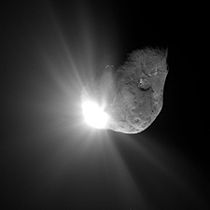
The Deep Impact mission
In the Star Trek universe, members of the United Federation of Planets often send messages, in a generally instantaneous manner. Whilst this is evidently a fictional scenario, it depicts in theory what an interplanetary Internet could look like, or at the least how communication between networks and hosts could occur over vast distances. In this particular instance, the system relies on the theory of "subspace", a realm of the universe through which data can pass instantly from any point.

In the Star Wars expanded universe, the Holonet functions much like an interplanetary version of the Internet, with near-instantaneous networking between computing devices over long distances. It is a major source of news and information, and is central to much of Galactic culture and history.

In Firefly/Serenity, the Anglo-Sino Alliance use an internet-like system across their extrasolar system called the cortex, and any transmissions across this net are called "waves."

The "extranet" of the Mass Effect universe is also an example of a fictional interplanetary Internet.


Earth orbit


Earth orbit is sufficiently nearby that conventional protocols can be used. For example, the International Space Station is connected to the terrestrial Internet.


Source- Wikipedia  

Related Posts Plugin for WordPress, Blogger...


website worth